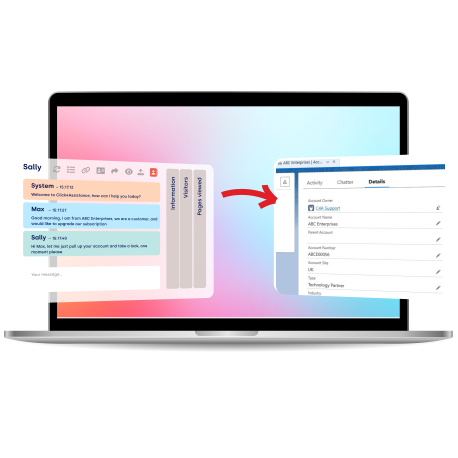
Find answers to frequently asked questions about implementing Click4Assistance on your website, including setup, configuration, deployment, customisation, website requirements, user experience, security, and extending customer engagement across digital channels.
How is Click4Assistance added to a website?
Click4Assistance is designed for straightforward implementation into existing websites.
In most deployments, the platform is added by including a small JavaScript snippet within the website. Once installed, administrators can configure the customer experience without requiring further website development.
This approach allows organisations to introduce Live Chat, AI Agents and Chatbots while maintaining their existing website and content management system.
Can Click4Assistance be added to any website?
Yes.
The platform is designed to integrate with virtually any modern website, regardless of the underlying technology or Content Management System (CMS).
Examples include:
- WordPress.
- Umbraco.
- Sitecore.
- Kentico.
- Drupal.
- Joomla.
- Shopify.
- Magento.
- Bespoke websites.
Implementation requirements may vary depending on the website architecture and security policies.
Does implementing Click4Assistance require a website redesign?
No.
The platform is designed to complement an existing website rather than replace it.
Most organisations can introduce customer engagement features without redesigning their website or changing their existing content management processes.
Can Live Chat be embedded within a webpage?
Yes.
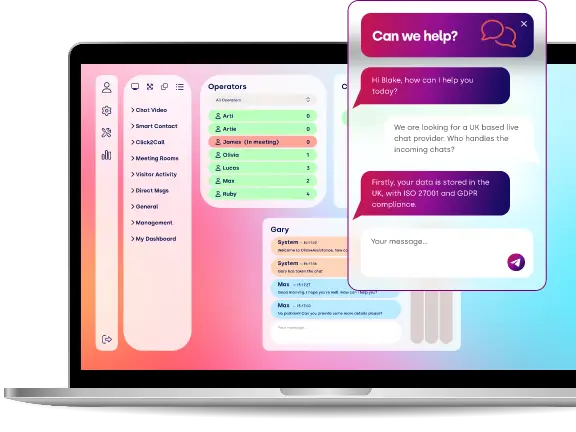
In addition to the traditional floating chat launcher, Live Chat and AI Agents can be embedded directly into a webpage.
This enables organisations to create more conversational digital experiences where assistance becomes part of the page rather than a separate pop-up window.
This approach is particularly effective for customer portals, product pages and support centres.
What is a Conversational Website?
A Conversational Website combines traditional web content with AI-powered interaction, allowing visitors to ask questions, complete tasks and receive personalised assistance without navigating through multiple pages.
Rather than replacing a website, conversational experiences enhance it by making information easier to access through natural language.
Click4Assistance enables organisations to embed AI directly into existing websites while connecting with business systems where appropriate.
Can different pages use different AI Agents?
Yes.
Different sections of a website can use AI Agents trained on knowledge relevant to that audience or service.
Examples include:
- Sales pages.
- Customer Support.
- Broker Portal.
- Student Admissions.
- Housing Repairs.
- HR Portal.
This enables organisations to deliver focused, context-aware conversational experiences.
Can AI be embedded into customer portals?
Yes.
AI can be integrated into secure customer portals to assist users with account management, service requests, documentation and frequently asked questions.
Where authorised integrations exist, AI can also interact with business systems to support personalised customer journeys.
Can AI be embedded into intranets?
Yes.
Many organisations deploy AI within internal intranets to help employees locate information, access policies, retrieve procedures and answer operational questions.
Internal AI can improve productivity by reducing the time employees spend searching for organisational knowledge.
Can organisations customise the embedded experience?
Yes.
Embedded experiences can be configured to reflect an organisation's branding, user journeys and operational requirements.
Examples include:
- Corporate branding.
- Welcome messages.
- Position within the page.
- AI Agent selection.
- Surveys.
- Escalation behaviour.
- Department routing.
This flexibility enables organisations to create conversational experiences that integrate naturally into their existing digital services.
Can Click4Assistance integrate with existing customer journeys?
Yes.
The platform is designed to enhance existing digital journeys rather than replace them.
Examples include:
- Quotation requests.
- Insurance applications.
- Student admissions.
- Housing repairs.
- Appointment booking.
- Customer authentication.
- Product selection.
- Technical support.
AI Agents can provide guidance throughout these journeys while connecting with existing business processes where appropriate.
Does embedded AI improve customer engagement?
Embedding AI within the content of a webpage allows customers to ask questions at the point they need assistance, reducing the need to search across multiple pages or leave the current task.
For many organisations, this creates a more intuitive and engaging digital experience while supporting increased self-service and improved customer satisfaction.
Can embedded AI collect customer information?
Yes.
Subject to the organisation's configuration, AI Agents can collect information such as contact details, enquiry information, booking requests and application data.
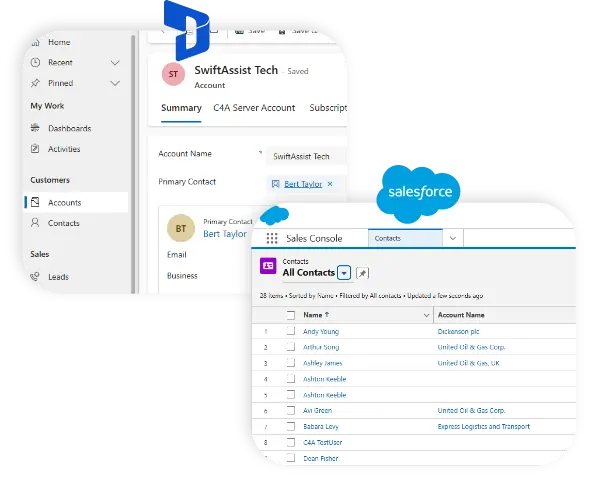
Where required, this information can be transferred securely to CRM systems, case management platforms or other authorised business applications.
Can organisations gradually introduce conversational experiences?
Yes.
Many organisations begin by deploying AI within a single section of their website before expanding to additional services.
This phased approach allows organisations to evaluate customer engagement, refine AI behaviour and build confidence before wider deployment.
Best practice for website integration
Successful website implementation focuses on improving the customer journey rather than simply adding another communication channel.
Recommended practices include:
- Embed AI where visitors naturally seek information.
- Keep branding consistent with the website.
- Use AI to complement existing navigation and content.
- Connect with business systems where appropriate.
- Provide a seamless route to human assistance when required.
- Monitor usage and refine experiences based on customer behaviour.
A well-designed conversational experience helps organisations improve customer engagement while making digital services simpler and more accessible.
Why integrate Click4Assistance with business systems?
Integrating Click4Assistance with existing business systems enables organisations to automate processes, reduce manual administration and provide more personalised customer experiences.
Rather than operating as a standalone communication tool, the platform can become part of wider business workflows, improving both operational efficiency and customer service.