Find answers to frequently asked questions about using Click4Assistance to enhance customer journeys, including AI Agents, Live Chat, digital self-service, customer engagement, industry use cases and delivering personalised support across digital channels.
How can an insurance broker use AI to improve customer service?
Insurance brokers receive large numbers of enquiries relating to quotations, renewals, policy changes and claims.
An AI Agent can answer common questions, collect customer information and guide visitors through the appropriate journey before transferring more complex enquiries to an advisor.
Typical benefits include:
- Reduced waiting times.
- Improved customer experience.
- Increased advisor productivity.
- Greater digital self-service.
Example customer journey – New insurance quotation
A visitor wants a quotation.
The customer journey might include:
- Visitor starts a conversation.
- AI identifies the type of insurance required.
- Basic qualification questions are asked.
- Information is collected.
- Customer is directed to an online quotation journey or advisor.
- CRM record created automatically.
- Advisor receives conversation history.
This reduces manual administration while improving lead quality.
Example customer journey – Existing customer support
An existing customer needs help with their policy.
The AI Agent can:
- Verify customer identity where appropriate.
- Answer policy questions.
- Explain renewal processes.
- Provide documentation.
- Update customer information.
- Escalate to an advisor if required.
This enables customers to receive assistance immediately while reducing demand on contact centre teams.
Example customer journey – Broker support
Many insurers provide dedicated broker support.
An AI Agent can assist brokers by:
- Answering underwriting questions.
- Providing product guidance.
- Explaining documentation requirements.
- Locating technical information.
- Directing enquiries to specialist teams.
This enables broker support teams to focus on complex underwriting enquiries.
Example customer journey – Claims assistance
During the claims process, AI can:
- Explain the claims journey.
- List required documentation.
- Provide contact details.
- Guide customers through next steps.
- Answer common questions.
- Escalate complex cases to claims handlers.
The AI supports the customer journey while ensuring claim decisions remain with appropriately authorised staff.
Example customer journey – Human escalation
A customer asks a complex question outside the AI Agent's approved knowledge.
The platform can:
- Transfer the conversation to an advisor.
- Preserve the conversation history.
- Pass collected information.
- Maintain the same customer experience.
Customers avoid repeating information while advisors receive valuable context.
Example customer journey – Out-of-hours support
A customer visits the website at 11:30 pm.
Although advisors are unavailable, the AI Agent can:
- Answer common questions.
- Explain products.
- Collect contact information.
- Arrange a callback.
- Capture the enquiry.
- Continue supporting the customer immediately.
This enables organisations to provide digital assistance 24 hours a day.
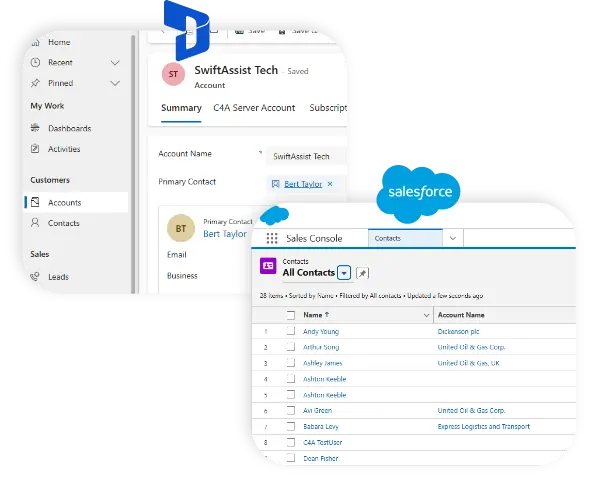
Example customer journey – CRM integration
During a conversation the AI Agent:
- Finds an existing customer.
- Retrieves relevant account information.
- Updates customer contact details.
- Creates a service request.
- Records the interaction.
The customer experiences one seamless conversation while business systems remain synchronised.
Example customer journey – AI and advisor collaboration
Rather than replacing advisors, AI and human expertise work together.
AI handles:
- Frequently asked questions.
- Information gathering.
- Qualification.
- Navigation.
- Simple requests.
Advisors handle:
- Advice.
- Decision making.
- Sensitive situations.
- Complex cases.
- Relationship management.
This combination enables organisations to increase efficiency while maintaining a high standard of customer service.
Best practice – Building successful customer journeys
Successful conversational journeys should focus on solving customer problems rather than showcasing technology.
Recommended practices include:
- Keep journeys simple and intuitive.
- Collect only the information required.
- Provide clear progress through the conversation.
- Integrate with existing business systems where appropriate.
- Offer human assistance whenever needed.
- Review journeys regularly based on customer feedback and reporting.
Well-designed customer journeys improve customer satisfaction, increase self-service and help organisations realise greater value from their customer engagement platform.
Example customer journey – University admissions
A prospective student visits the university website with questions about available courses.
The AI Agent can:
- Answer questions about courses and entry requirements.
- Explain tuition fees and funding options.
- Direct students to open day information.
- Collect enquiry details.
- Book appointments with admissions staff.
- Transfer complex enquiries to an admissions advisor.
This provides immediate assistance while reducing administrative workload.