Find answers to frequently asked questions about the Click4Assistance AI Agent platform, including features, functionality, integrations and capabilities.
What is an AI Agent?
An AI Agent is an intelligent software assistant that understands natural language, answers questions and assists users through conversations. Unlike traditional rule-based chatbots, AI Agents interpret customer intent and generate contextually relevant responses using large language models and organisational knowledge.
Within the Click4Assistance platform, AI Agents can answer questions, guide users through processes, capture information, complete business workflows and seamlessly transfer conversations to human advisors whenever appropriate.
What is C4AAI?
C4AAI is Click4Assistance's proprietary Artificial Intelligence platform. It enables organisations to deploy intelligent AI Agents across websites, customer portals, mobile applications and business systems.
Unlike AI solutions designed for a single purpose, C4AAI is an API-first platform that operates within the Click4Assistance customer engagement platform and can also be integrated with third-party applications.
What can an AI Agent do?
An AI Agent can perform many customer service and business functions, including:
- Answer customer questions
- Provide product information
- Guide users through processes
- Complete forms
- Capture leads
- Retrieve information
- Authenticate users
- Book appointments
- Recommend products or services
- Escalate conversations to human advisors
- Integrate with CRM and business systems
The available capabilities depend on how the AI Agent has been configured and integrated.
How is an AI Agent different from a chatbot?
Traditional chatbots generally follow predefined conversation flows based on rules and decision trees.
AI Agents use large language models to understand natural language, interpret customer intent and generate responses using organisational knowledge. This enables them to answer a much wider range of questions without requiring every possible conversation path to be created in advance.
Many organisations use both technologies together, with chatbots managing structured workflows while AI Agents provide more flexible conversational support.
Does an AI Agent replace human advisors?
No. AI Agents are designed to complement human advisors rather than replace them.
They are particularly effective at handling routine enquiries, frequently asked questions and repetitive tasks, allowing advisors to focus on conversations that require judgement, empathy or specialist expertise. Where appropriate, AI Agents can seamlessly transfer conversations to human advisors.
How do AI Agents learn?
AI Agents do not learn from conversations in the same way people do. Instead, they generate responses using large language models together with the knowledge sources provided by the organisation.
Improving an AI Agent typically involves updating its knowledge sources, refining instructions and adjusting business rules rather than retraining the underlying language model.
What information can an AI Agent be trained on?
AI Agents can be configured using a wide range of organisational knowledge, including:
- Websites
- PDF documents
- Microsoft Word documents
- CSV spreadsheets
- Knowledge bases
- FAQs
- Product documentation
- Policies
- Procedures
- CRM information
- Business systems
- Secure APIs
This enables organisations to make existing knowledge available through conversational AI.
Can AI Agents answer questions from a website?
Yes. One of the quickest ways to deploy an AI Agent is by training it using the content already published on an organisation's website.
The AI Agent can then answer visitor questions based on that information while continuing to reference the organisation's latest published content as it is updated.
Can AI Agents answer questions from PDF documents?
Yes. AI Agents can use information contained within PDF documents as part of their knowledge base.
Typical examples include:
- Product brochures
- User guides
- Policy documents
- Annual reports
- Technical manuals
- Knowledge articles
This enables organisations to reuse existing documentation without rewriting content.
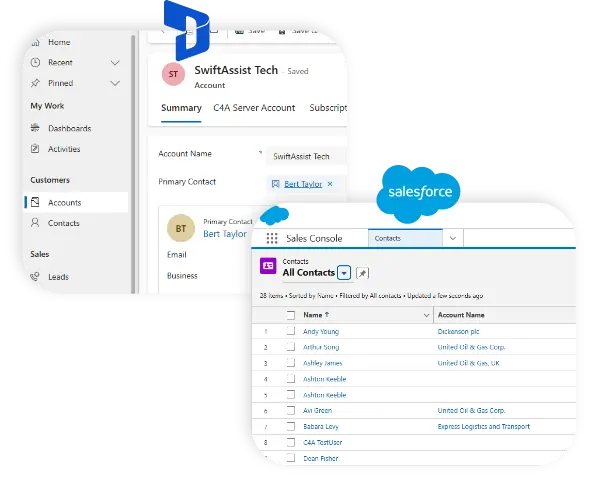
Can AI Agents use information from business systems?
Yes. Through secure APIs and integrations, AI Agents can retrieve information from authorised business systems where appropriate.
Examples include:
- CRM systems
- Customer accounts
- Booking systems
- Knowledge bases
- Inventory systems
- Internal applications
This enables AI responses to include current business information rather than relying solely on static documentation.
Can AI Agents complete tasks?
Yes. In addition to answering questions, AI Agents can be configured to initiate business processes such as:
- Booking appointments
- Completing forms
- Creating support tickets
- Collecting customer information
- Sending notifications
- Updating CRM systems
- Triggering workflows through APIs
The available functionality depends on the organisation's integrations and business requirements.
Can AI Agents collect customer information?
Yes. AI Agents can collect information during conversations, including names, contact details, enquiry information and other business-specific data.
Collected information can be validated, securely stored and passed into other business systems where appropriate.
Can AI Agents complete forms?
Yes. Rather than presenting long static forms, AI Agents can guide users through a conversational process, asking one question at a time and validating responses before progressing.
This can improve completion rates and create a more user-friendly experience.
Can AI Agents authenticate customers?
Yes. Where integrated with appropriate authentication systems, AI Agents can guide users through identity verification processes before providing access to personalised information or services.
Authentication methods depend on the organisation's security policies and existing systems.
Can AI Agents recommend products or services?
Yes. AI Agents can ask questions to understand customer requirements before recommending suitable products, services or next steps based on the information available.
Recommendations can be supported by business rules, knowledge sources or integrations with other systems.
Can AI Agents transfer conversations to humans?
Yes. Human escalation is an important feature of the Click4Assistance platform.
AI Agents can transfer conversations to human advisors whenever the customer requests human assistance. Conversation history is retained, allowing advisors to continue the discussion without the customer needing to repeat information.
Can organisations control how AI responds?
Yes. Organisations remain in control of their AI Agent through configurable instructions, approved knowledge sources, business rules and workflow settings.
This governance helps ensure responses align with organisational policies and customer service standards.
Does Click4Assistance build custom AI Agents?
Yes. Click4Assistance works with organisations to configure AI Agents that reflect their specific products, services, terminology and business processes.
AI deployments can range from answering frequently asked questions through to integrating with complex enterprise workflows.
Can AI Agents work 24 hours a day?
Yes. AI Agents can provide assistance 24 hours a day, seven days a week.
This enables organisations to offer support outside normal business hours while routing more complex enquiries to human advisors when they become available.
Why are AI Agents becoming increasingly popular?
Organisations are increasingly adopting AI Agents because they help improve customer experience while increasing operational efficiency.
They can provide immediate responses, automate repetitive enquiries, support customers outside business hours and reduce pressure on customer service teams. When deployed alongside human advisors, AI Agents allow organisations to scale customer engagement without compromising service quality.
Can AI Agents complete tasks?
Yes.
In addition to answering questions, AI Agents can be configured to initiate business processes such as:
- Booking appointments
- Completing forms
- Creating support tickets
- Collecting customer information
- Sending notifications
- Updating CRM systems
- Triggering workflows through APIs
The available functionality depends on the organisation's integrations and business requirements.
Can AI Agents collect customer information?
Yes.
AI Agents can collect information during conversations, including names, contact details, enquiry information and other business-specific data. Collected information can be validated, securely stored and passed into other business systems where appropriate.
Can AI Agents complete forms?
Yes.
Rather than presenting long static forms, AI Agents can guide users through a conversational process, asking one question at a time and validating responses before progressing. This can improve completion rates and create a more user-friendly experience.
Can AI Agents authenticate customers?
Yes.
Where integrated with appropriate authentication systems, AI Agents can guide users through identity verification processes before providing access to personalised information or services. Authentication methods depend on the organisation's security policies and existing systems.
Can AI Agents recommend products or services?
Yes.
AI Agents can ask questions to understand customer requirements before recommending suitable products, services or next steps based on the information available. Recommendations can be supported by business rules, knowledge sources or integrations with other systems.
Can AI Agents transfer conversations to humans?
Yes.
Human escalation is an important feature of the Click4Assistance platform. AI Agents can transfer conversations to human advisors when the customer requests human assistance. Conversation history is retained, allowing advisors to continue the discussion without the customer repeating information.
Can organisations control how AI responds?
Yes.
Organisations remain in control of their AI Agent through configurable instructions, approved knowledge sources, business rules and workflow settings. This governance helps ensure responses align with organisational policies and customer service standards.
Does Click4Assistance build custom AI Agents?
Yes.
Click4Assistance works with organisations to configure AI Agents that reflect their specific products, services, terminology and business processes. AI deployments can range from answering frequently asked questions through to integrating with complex enterprise workflows.
Can AI Agents work 24 hours a day?
Yes.
AI Agents can provide assistance 24 hours a day, seven days a week. This enables organisations to offer support outside normal business hours while routing more complex enquiries to human advisors when they become available.
Why are AI Agents becoming increasingly popular?
Organisations are increasingly adopting AI Agents because they help improve customer experience while increasing operational efficiency. They can provide immediate responses, automate repetitive enquiries, support customers outside business hours and reduce pressure on customer service teams. When deployed alongside human advisors, AI Agents allow organisations to scale customer engagement without compromising service quality.
Can AI Agents transfer conversations to humans?
Yes.
Human escalation is an important feature of the Click4Assistance platform. AI Agents can transfer conversations to human advisors whenever a customer requests assistance or when predefined business rules require it. Conversation history is retained, allowing advisors to continue the discussion without customers repeating information.
Can organisations control how AI responds?
Yes.
Organisations remain in control of their AI Agents through configurable instructions, approved knowledge sources, business rules and workflow settings. This governance helps ensure responses remain aligned with organisational policies and customer service standards.
Does Click4Assistance build custom AI Agents?
Yes.
Click4Assistance works with organisations to configure AI Agents that reflect their products, services, terminology and business processes. Deployments can range from answering frequently asked questions to supporting complex enterprise workflows through integrations and automation.
Can AI Agents work 24 hours a day?
Yes.
AI Agents can provide assistance 24 hours a day, seven days a week. This enables organisations to support customers outside normal business hours while transferring more complex enquiries to human advisors when they become available.
Why are AI Agents becoming increasingly popular?
Organisations are increasingly adopting AI Agents because they help improve customer experience while increasing operational efficiency.
They provide immediate responses, automate repetitive enquiries, support customers outside normal business hours and reduce pressure on customer service teams. Used alongside human advisors, AI Agents help organisations scale customer engagement without compromising service quality.
What Large Language Models (LLMs) can C4AAI use?
C4AAI has been designed as a model-agnostic platform, allowing organisations to use appropriate Large Language Models (LLMs) as AI technology evolves.
The Click4Assistance platform provides the orchestration, security, integrations and governance around the chosen AI model, enabling organisations to benefit from advances in AI without replacing their customer engagement platform.
Does Click4Assistance use OpenAI?
Yes.
C4AAI can utilise OpenAI's business APIs as one of the underlying language models used to generate responses. Click4Assistance adds enterprise capabilities including knowledge management, security, business workflows, integrations, reporting, governance and seamless escalation to human advisors.
Does OpenAI own my data?
No.
Customer data remains under the control of the customer and Click4Assistance. When OpenAI business APIs are used, prompts and responses are processed in accordance with OpenAI's business terms. OpenAI states that content submitted through its business APIs is not used to train its public models by default. Customers should review the applicable OpenAI documentation and contractual arrangements.
Is customer data used to train AI models?
No.
Click4Assistance does not use customer conversations, documents or organisational knowledge to train public AI models. Customer knowledge remains dedicated to each organisation's own AI implementation.
What makes C4AAI different from using ChatGPT directly?
ChatGPT is a general-purpose conversational AI, whereas C4AAI is an enterprise AI platform designed for business use.
C4AAI combines conversational AI with:
- Organisational knowledge
- Business rules
- Authentication
- Secure APIs
- CRM integration
- Reporting
- Governance
- Human escalation
- Enterprise security controls
This enables organisations to deploy AI safely within real business processes rather than relying on a general-purpose assistant.
Can AI Agents access live business information?
Yes.
Where appropriate integrations exist, AI Agents can retrieve authorised information from business systems in real time. Examples include customer account information, appointment availability, policy information, booking systems, CRM records and internal knowledge bases. This enables responses to reflect current business information rather than static documentation.
What is Retrieval-Augmented Generation (RAG)?
Retrieval-Augmented Generation (RAG) is an approach where an AI Agent retrieves relevant information from trusted knowledge sources before generating a response.
Rather than relying solely on the underlying language model, the AI uses an organisation's own content, such as websites, documents and knowledge bases, to provide more accurate and relevant answers. This helps improve accuracy and ensures responses are grounded in approved information.
Why is RAG important?
RAG helps organisations provide more accurate and trustworthy AI responses by referencing approved organisational information instead of relying only on the AI model's general knowledge.
Key benefits include:
- Improved response accuracy
- Reduced incorrect responses
- Answers aligned with company policies
- Support for the latest published information
- Reduced likelihood of AI hallucinations
What are AI hallucinations?
An AI hallucination occurs when an AI model generates information that appears plausible but is incorrect, unsupported or fabricated.
Hallucinations are a recognised characteristic of generative AI and can occur with any large language model. Using trusted knowledge sources, clear instructions, business rules and human oversight can significantly reduce their occurrence.
How does Click4Assistance reduce AI hallucinations?
Click4Assistance encourages organisations to ground AI responses in trusted organisational knowledge rather than relying solely on the language model.
Additional controls include:
- Approved knowledge sources
- Configurable instructions
- Business rules
- API integrations
- Human escalation
- Ongoing testing and refinement
These measures help improve response quality while recognising that no AI system can guarantee complete accuracy in every situation.
Can AI Agents refuse to answer questions?
Yes.
AI Agents can be instructed to:
- Decline questions outside their knowledge
- Redirect users to appropriate resources
- Request clarification
- Transfer conversations to a human advisor
This helps maintain accuracy and ensures customers receive appropriate assistance.
Can organisations control what AI talks about?
Yes.
Customers determine the knowledge sources, instructions and business rules used by their AI Agent. This enables organisations to define the scope of the AI's responsibilities and restrict responses to approved subject areas where appropriate.
Can AI follow business rules?
Yes.
In addition to understanding natural language, AI Agents can operate within configurable business rules, including:
- Requiring customer authentication
- Escalating sensitive enquiries
- Restricting certain responses
- Collecting mandatory information
- Triggering automated workflows
This allows organisations to combine conversational AI with structured business processes.
Can AI Agents integrate with existing workflows?
Yes.
AI Agents can form part of wider business processes by interacting with APIs, CRM systems, ticketing platforms and other enterprise applications. Rather than operating in isolation, AI becomes an integral part of customer service, sales and operational workflows.
Can AI improve customer experience?
Yes.
AI Agents provide immediate assistance, answer questions consistently and remain available outside normal business hours. When combined with human advisors, they reduce waiting times while ensuring more complex enquiries receive the appropriate level of human support, creating a faster and more responsive customer experience.
Can AI reduce operational costs?
Yes.
By automating routine enquiries and repetitive tasks, AI Agents can reduce the workload placed on customer service teams. This enables advisors to focus on higher-value conversations while increasing the number of customer enquiries handled efficiently. The greatest benefits are typically achieved when AI and human advisors work together.
Can AI improve employee productivity?
Yes.
AI can assist employees by answering internal questions, retrieving knowledge, drafting responses and automating routine processes. This enables staff to spend less time searching for information and more time focusing on activities that require human judgement.
Can AI support internal teams?
Yes.
Many organisations deploy AI Agents internally to assist employees with policies, procedures, HR information, IT support and internal documentation. This provides staff with immediate access to organisational knowledge while reducing demand on internal support teams.
Is AI suitable for every customer enquiry?
Not always.
AI is particularly effective for answering routine questions, providing information, guiding users through processes and automating repetitive tasks. However, some situations are better handled by human advisors, particularly those involving complex decision-making, complaints, safeguarding, sensitive personal circumstances or negotiations. The most effective customer engagement strategies combine AI with skilled human advisors.
Why choose C4AAI?
C4AAI provides organisations with more than access to a large language model. It combines conversational AI with enterprise governance, secure integrations and customer engagement capabilities to create AI solutions that operate within real business environments.
Key capabilities include:
- AI Agents trained on organisational knowledge
- API-first architecture
- Integration with existing business systems
- Human escalation
- Enterprise security
- UK-developed platform
- Support for regulated industries
- Modular deployment
- Comprehensive reporting and management tools
This enables organisations to introduce AI confidently while maintaining control over customer interactions, organisational knowledge and business processes.