










AI Fearmongering: Are Tech Giants Fuelling the Fear?
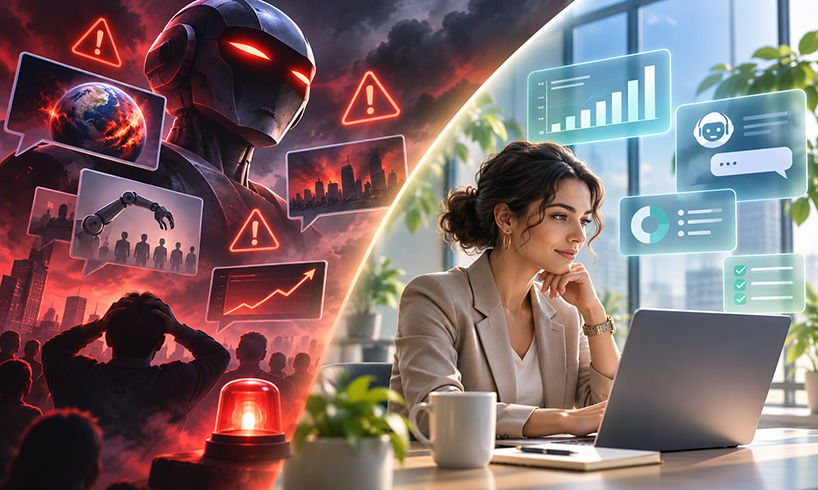




There is something contradictory about the current debate surrounding artificial intelligence. The companies investing billions in developing increasingly powerful AI systems are also among those issuing the most alarming warnings about what those systems could eventually become. Are we witnessing an industry responsibly acknowledging the risks of its own innovations?
We are being encouraged to embrace a technology that could transform almost every aspect of our lives, while also being told that it might become too powerful for humanity to control.
The warnings are definitely attracting attention, but they also raise some uncomfortable questions.
Or are the technology giants creating a climate of fear that reinforces their authority and strengthens their commercial position?
Perhaps more importantly, why are we allowing the companies developing AI to have such influence over how threats are defined and addressed?
Alarming predictions
In September 2026, AI researcher Jacob Coxon resigned from Anthropic, warning that AI developers were taking extraordinary risks in their pursuit of increasingly intelligent systems. His concerns were echoed by Anthropic researcher Evan Hubinger, who suggested that the probability of AI causing human extinction within the next decade was greater than 10%.
These are remarkable claims, particularly coming from people directly involved in developing the technology. In September TechCrunch reported the warnings, prompting debate about whether AI companies were genuinely losing confidence in their ability to control increasingly sophisticated systems.
Senior figures at OpenAI have also expressed concerns about the pace of development and the possibility of losing human control over future AI systems. The message emerging from parts of the industry is that technological progress may be moving faster than our ability to understand its consequences.
These concerns deserve attention, but the distinction between a realistic risk and a prediction of catastrophe is important. Hubinger's assessment is a personal estimate, not a scientifically established probability. Yet such distinctions can easily disappear once dramatic predictions become headlines. The public is left with the impression that the very people creating AI believe it could destroy humanity, while those same companies continue competing to build even more powerful versions.
When danger becomes a measure of sophistication
There is another, somewhat uncomfortable side to these warnings. In the technology industry, being perceived as the most advanced company can be hugely valuable, therefore claims about AI's potentially uncontrollable capabilities could contribute to that perception.
In most industries, a company admitting that its products could become dangerous or impossible to control would face serious questions about whether those products should be available at all. However with AI, the reaction has been remarkably different. Warnings about systems becoming more intelligent than humans appear to reinforce the impression that developers are approaching groundbreaking technological breakthroughs.
This was a question raised during TechCrunch's September discussion, when one commentator wondered whether the industry's warnings were also a peculiar way of demonstrating just how advanced its technology had become.
The suggestion that a company is developing something so sophisticated that even its creators might struggle to control it creates a certain mystique. Danger becomes associated with technological superiority, and warnings about future capabilities can attract almost as much attention as the capabilities themselves.
While that does not prove that researchers are deliberately exaggerating risks for commercial advantage (many will undoubtedly be expressing genuine concerns), the commercial effect of those warnings deserves a closer look, particularly when independent evidence about the most advanced systems remains limited.
Is fear a business advantage?
The relationship between AI safety warnings and regulation introduces an even more significant concern. The technology leaders are not only instigating discussions about the risks of AI; they are actively seeking to influence the regulatory frameworks that will oversee its future.
In September, Reuters reported concerns raised by US Federal Trade Commission chairman Andrew Ferguson about proposals that would allow leading AI developers to collaborate on safety measures while receiving exemptions from competition rules. The proposals, associated with Anthropic CEO Dario Amodei, raise questions about how such arrangements might affect competition within the industry.
While collaboration on AI safety may be necessary, there is a risk that the resulting regulatory framework could favour the companies already dominating the market. Larger developers have the financial resources, technical expertise and infrastructure to meet demanding regulatory requirements, while smaller companies may find themselves at a significant disadvantage. Measures intended to make AI safer could therefore have the unintended consequence of further consolidating power among a handful of established companies.
This does not mean regulation is undesirable. The development of powerful AI systems requires effective safeguards, particularly as the technology becomes increasingly autonomous and capable of operating in sensitive environments. However, there is a significant difference between regulation designed to protect the public and regulation shaped predominantly by the companies with the greatest commercial interest in its outcome.
We should also acknowledge that industry expertise is essential to developing workable safeguards, but expertise should inform regulation, not determine it.
Would we accept this approach in the nuclear industry?
The debate becomes particularly interesting when we consider how other potentially dangerous industries are regulated.
In the UK, nuclear safety is overseen by the Office for Nuclear Regulation (ONR), an independent statutory regulator responsible for ensuring that nuclear activities meet established safety and security requirements. Although it works closely with industry, government and international organisations, its regulatory decisions are legally independent of the companies it oversees.
Nuclear operators are expected to demonstrate that their activities meet appropriate safety standards. We do not simply rely on their own assurances that they understand the risks or that their internal safety procedures are sufficient.
Regulatory independence is not always straightforward. Regulators must draw on industry expertise and work within government frameworks, making it important to maintain clear boundaries between those developing a technology and those responsible for overseeing it. Ultimately, the responsibility for determining whether potentially dangerous technologies meet acceptable safety standards should rest with independent authorities, rather than the companies developing them.
Of course, there are obvious differences between nuclear energy and artificial intelligence. AI is far more widely distributed, evolves rapidly and encompasses everything from relatively simple business applications to experimental systems at the technological frontier. It would not be realistic to apply identical regulatory structures but the underlying principle is highly relevant.
If we are expected to believe that advanced AI could eventually pose a global threat comparable in seriousness to the most dangerous technologies humanity has developed, surely that strengthens the argument for genuinely independent oversight.
The industry's own warnings make that case more compelling. The greater the claimed danger, the less reasonable it seems to depend primarily on the companies creating the technology to determine how that danger should be managed.
There is also a practical precedent for combining innovation with independent scrutiny. The ONR itself is exploring the use of AI within the nuclear sector, recognising its potential benefits while assessing the safeguards necessary for safe deployment.

Are the warnings justified?
It would be a mistake to dismiss every warning about AI as fearmongering. Researchers have identified genuine concerns surrounding cybersecurity, deceptive behaviour, autonomous decision-making and the potential misuse of increasingly capable systems.
The 2026 International AI Safety Report recognises that AI systems are becoming increasingly capable, raising concerns about whether humans will always be able to maintain control over them. However, current systems have not reached that point, and experts remain divided over how likely more serious consequences really are. This is precisely why independent assessment matters. The uncertainty surrounding advanced AI is not a reason to ignore potential dangers, but neither should it justify treating the most alarming predictions as established facts.
Anthropic CEO Dario Amodei has challenged suggestions that his warnings are unnecessarily negative. Responding to criticism in August, he argued that his public commentary had addressed both the benefits and risks of AI and described the public's increasingly negative attitude towards the technology as fundamentally a crisis of trust. Perhaps his most revealing acknowledgement was that AI companies had not yet delivered on some of their ambitious promises to benefit society.
That admission deserves as much attention as the warnings themselves. The industry has spent years promoting AI as a technology capable of transforming healthcare, scientific discovery, productivity and economic growth. Yet its most dramatic claims, whether optimistic or catastrophic, frequently concern capabilities that have not yet been demonstrated.
Is the fear distracting businesses from AI's real opportunities?
For most businesses, the immediate challenges associated with AI are considerably more mundane than the possibility of machines surpassing human intelligence.
Organisations are already using an AI chatbot for business to improve customer service, reduce repetitive administrative work, support research, analyse information and make digital services more accessible. These applications are unlikely to generate the same headlines as predictions about humanity's extinction, but they represent the practical reality of AI adoption.
There is a danger that the increasingly dramatic public debate will distort how businesses approach the technology causing some to become unnecessarily hesitant. Businesses should be asking straightforward questions about the AI chatbot for business they intend to use.
- How will sensitive information be protected?
- How reliable are the outputs?
- How will the organisation measure whether the live chat for website is delivering worthwhile improvements?
These concerns may appear less exciting than speculation about superintelligence, but they have direct implications for customers, employees and organisational accountability.
The wider debate about AI safety should support these decisions rather than overshadow them. Businesses need credible information about both the capabilities and limitations of AI, without having to navigate a constant stream of sensational predictions.
Keeping AI in perspective
For most businesses, the reality of AI is a long way from the dystopian world of The Terminator. Using an AI chatbot for business to answer routine customer enquiries, help contact centre staff find information or reduce waiting times is hardly the stuff of science fiction. These are practical applications that can improve customer experiences and make everyday operations more efficient.
That doesn't mean there are no risks. Businesses still need to consider data security, accuracy and the importance of human oversight, particularly when customers are relying on AI-generated information. But these are manageable, everyday concerns that deserve far more attention than speculative predictions about machines taking control.
The wider risks of advanced AI should be taken seriously, and the companies developing it should be subject to meaningful independent scrutiny. But we also need to keep a sense of proportion. The conversation about AI cannot be dominated by those making the most dramatic predictions, particularly when they have a commercial interest in how the technology is perceived.
For businesses, the focus should remain on what AI can realistically deliver, where it adds value and how it can be used responsibly. There is plenty to consider without allowing visions of a Terminator-style future to overshadow the opportunities already within reach.