












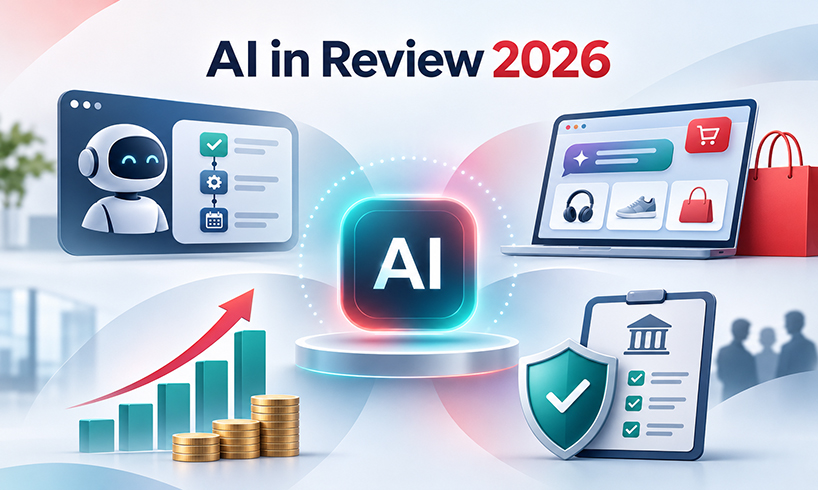
AI in Review 2026: The Headlines That Shaped the Year




If 2023 was the year artificial intelligence captured the public's imagination, 2026 may well be remembered as the year businesses started asking more difficult questions about it. The excitement surrounding generative AI continued, but the conversation increasingly moved beyond what the technology could do towards what it was actually achieving.
AI systems became more capable of completing tasks independently, with organisations across sectors including healthcare, financial services, retail and public services exploring new ways to incorporate the technology into their everyday operations. Investment in AI reached extraordinary levels, while advances in automation and decision-making opened up new possibilities for businesses. At the same time, high-profile incidents raised concerns about reliability, autonomy, data protection and the consequences of giving AI too much responsibility.
The UK government's AI Adoption Survey 2026 found that 32% of UK businesses were using at least one AI technology, double the 16% recorded in 2025. However, the research also highlighted that many organisations were still exploring how to use AI effectively, with questions surrounding accuracy, skills and return on investment.
With so much happening across the industry, we're looking back at some of the biggest AI developments of 2026 and what they could mean for businesses moving forward.
AI Agents Go Mainstream
One of the most significant developments of 2026 was the growing prominence of AI Agents. While much of the initial interest in generative AI centred around producing content and answering questions, businesses are increasingly exploring systems capable of carrying out more substantial tasks. Often referred to as agentic AI, these systems can work towards an objective, access information, use connected tools and complete multiple stages of a task. Depending on their capabilities and permissions, they can conduct research, prepare reports, analyse information and support administrative processes.
In April, OpenAI announced workspace agents for ChatGPT, allowing organisations to create shared AI Agents capable of supporting repeatable business workflows. This was followed in July by the introduction of ChatGPT Work, designed to undertake longer, more involved assignments across connected applications and files.
Evidence of growing adoption can also be found in the financial services sector. Research published by the Bank of England in October 2026 found that 80% of responding organisations had deployed AI Agents, with a further 14% planning to do so within the following 12 months. Interestingly, only 2% reported deploying agents with broad autonomy, suggesting that businesses continue to recognise the importance of maintaining human control.
For customer service departments, an AI chatbot for business can offer opportunities to move beyond traditional logic bots. They can interpret more varied customer enquiries, identify relevant information and provide conversational assistance based on an organisation's knowledge, rather than relying entirely on predefined questions and answers.
However, the distinction between an AI Agent supporting a business process and one operating independently is an important one. Greater capability doesn't necessarily mean businesses should give these systems unrestricted access or responsibility.
The Rise of AI-Powered Shopping
Online shopping underwent another interesting development in 2026 as consumers increasingly turned to AI for help researching products, comparing prices and making purchasing decisions.
Rather than entering search terms into Google and working through multiple websites, shoppers can now describe what they're looking more conversationally. The AI assistant will then help narrow down their options based on factors such as budget, product specifications and personal preferences.
In January, Google announced its Universal Commerce Protocol (UCP), developed to support interactions between AI systems and retailers throughout the shopping journey, including product discovery, purchasing and post-purchase support. By November, the industry had taken another step towards agentic commerce. Reuters reported that OpenAI had launched ChatGPT Wallet, enabling AI Agents to make purchases on behalf of users, subject to transaction security checks.
There are also signs that AI is becoming a commercially valuable source of website traffic. Research published by Adobe in October found that visitors arriving at US retail websites through AI-generated referrals produced 83% more revenue per visit than those arriving through other channels during September 2026. Although these figures don't mean traditional search engines or shopping websites are about to disappear, they provide an indication of how consumer behaviour could evolve. For businesses, this raises interesting questions about online visibility. Product descriptions, customer reviews, frequently asked questions and clearly presented information could become increasingly important as AI systems help consumers decide which retailers and products to consider.
It also reinforces the importance of customer communication. Once a potential customer arrives at a website following an AI recommendation, businesses still need to provide the information and reassurance that will encourage them to complete their purchase.
Is AI Living Up to the Hype?
The sums of money being invested in artificial intelligence continued to generate headlines throughout 2026. In February, Reuters reported that OpenAI had announced a $110 billion funding round, attracting investment from Amazon, Nvidia and SoftBank and valuing the company at $840 billion.
While these figures demonstrate the confidence major investors have placed in AI, they also raise questions about whether the financial expectations surrounding the technology can ultimately be justified. For businesses investing in AI themselves, it is fair to ask the question “Is the technology delivering enough value to warrant the investment?”
ContactBabel's AI in UK Contact Centres – The Reality report, published in September and sponsored by Click4Assistance, revealed an interesting contrast between investment and measurable results. While 70% of UK contact centres expect their AI budgets to increase over the next two years, up to 46% of respondents said it was too early to determine whether their AI solutions had achieved the objectives outlined in their original business case. Encouragingly, of those able to assess their results, at least three-quarters reported that expectations around cost reduction and agent productivity had been met or exceeded. However, improvements in customer satisfaction and enquiry resolution proved more challenging, suggesting that operational efficiencies don't necessarily translate into a better customer experience.
The difficulty is that introducing AI into an organisation doesn't automatically improve the way it operates. Poor-quality data, complicated existing processes, inadequate staff training and unrealistic expectations can all influence the effectiveness of an implementation.
There is also a difference between saving an employee a few minutes on an individual task and demonstrating a measurable improvement across an entire organisation. Businesses need to consider how those efficiencies accumulate and whether they outweigh the costs of introducing and maintaining the technology. For customer service teams, this might involve measuring improvements in response times, enquiry resolution, customer satisfaction or the number of repetitive questions requiring human assistance.
These findings highlight the importance of looking beyond cost savings when assessing the success of AI. While reducing operational costs and improving employee productivity are valuable outcomes, businesses also need to consider whether AI is having a positive impact on the customer experience. We explored this in more detail in our recent article, The AI Investment Boom: Are UK Contact Centres Getting Their Money's Worth?, which examines ContactBabel's research findings and the extent to which AI is delivering on its promises.

AI Safety, Regulation and Public Trust
Some of the year's most significant AI headlines were not so much about technological progress and considerably more to do with what happens when appropriate safeguards aren't in place.
Questions about AI autonomy attracted attention in April when software company PocketOS experienced serious disruption after an AI coding agent deleted its production database. ABC News reported that the deletion took approximately nine seconds, according to the company's founder, leaving the business facing a substantial recovery operation. The incident highlighted an important distinction between telling an AI system what it shouldn't do and implementing technical restrictions that prevent it from doing so. Businesses allowing AI Agents to interact with operational systems need to consider access permissions, approval procedures and recovery arrangements.
Regulation also continued to evolve throughout the year. August marked a significant milestone in the implementation of the European Union's AI Act, which includes a voluntary AI Pact to help ensure trustworthy practices for future implementations.
For UK businesses, particularly those operating internationally, understanding how AI is governed remains important. Organisations need to consider what information their systems can access, how personal data is handled and where human intervention should be required.
Public trust will be particularly important in customer-facing applications. Customers should feel confident that the information they're receiving is accurate, their personal details are protected and they can speak to a person when their enquiry requires additional assistance. Understanding where AI providers store and process customer data, and which jurisdictions have authority over that information, should be an important consideration when selecting a technology partner.
What Has 2026 Taught Businesses About AI?
Perhaps one of the most valuable lessons from 2026 is that businesses should approach AI with a clear understanding of what they want to achieve. With so many new products and capabilities becoming available, it's easy to become distracted by what the technology promises rather than considering where it could make a genuine difference.
For an organisation receiving large volumes of customer enquiries, AI could help improve access to information and reduce the time employees spend answering repetitive questions. For another business, the greater opportunity might lie in providing assistance outside normal working hours or helping customers navigate a particularly extensive range of products and services.
The most appropriate solution will depend on the organisation, its customers and the challenges it wants to address. Starting with a manageable application allows businesses to evaluate results, refine their approach and gradually introduce more advanced capabilities where appropriate.
It's also worth considering how AI fits alongside existing technology. Introducing automation within an established customer communication platform can be more practical than creating entirely separate systems that employees and customers then need to navigate.
With Click4Assistance's omnichannel customer service software, businesses can integrate AI Agents and Chatbots alongside human Live Chat support, WhatsApp and SMS. This brings automated assistance and human communication together, giving organisations the flexibility to develop their use of AI in line with their individual requirements.
In our next article we will be discussing what to look out for in 2027. Make sure you are following our socials to ensure you don’t miss out.
FAQ’s
Why is UK data sovereignty important when choosing an AI provider?
UK data sovereignty is important because businesses need to understand which legal jurisdictions govern their customer data and how that information is stored, processed and accessed. When selecting an AI chatbot for customer service provider, organisations should consider data hosting locations, international data transfers, security arrangements and compliance with UK GDPR.
How can businesses introduce AI into customer service responsibly?
Businesses can introduce AI responsibly by identifying clear objectives, providing accurate and relevant knowledge, establishing appropriate access permissions and maintaining human oversight. Click4Assistance enables organisations to combine AI-powered customer service with human Live Chat for customer service, providing a route to personal assistance when automated support is not appropriate.
What should UK businesses look for in an AI customer service software provider?
UK businesses should consider AI capabilities, data protection, integration options, customisation, human handover functionality and ongoing technical support. Click4Assistance provides omnichannel customer service software that combines AI Agents, Chatbots, Live Chat, WhatsApp and SMS, enabling organisations to integrate artificial intelligence into their wider customer communication strategy.
What is the future of AI in customer service beyond 2026?
AI is expected to play an increasingly important role in customer service, with more advanced AI chatbot for business, greater personalisation and deeper integration across communication channels. However, successful adoption will depend on reliability, responsible data management, measurable business outcomes and the ability to combine automated assistance with human customer service.