












When Coni and Arti Work Together: A Different Kind of Valentine’s Story




Valentine’s Day is one of those moments in the calendar that quietly divides opinion. Some people enjoy it, some tolerate it, some ignore it entirely. In professional lives, its rarely acknowledged.
Traditionally, Valentine’s Day is about grand gestures such as roses and cards delivered once a year, sometimes anonymously. While there is no harm in taking a day to focus the attention and celebrate romance, we need to talk about relationships more broadly: how people relate to each other, how expectations are set, and how meaning is created through small, repeated interactions.
Those same dynamics show up at work all the time, even if we use different language. We talk about trust, alignment, reliability, handovers, and accountability. We notice when things ‘just work’ together, and we feel it immediately when they don’t. Most of the time, the difference has very little to do with talent or capability, and a lot to do with roles and boundaries.
It’s an interesting moment to reflect on that, because many organisations are now having similar experiences with AI. Not at the level of individual tools or features, but at the level of relationships: how systems interact with each other, how they interact with people, and how responsibility is shared when things become ambiguous.
Seen in that way, how Coni and Arti work together is less a story about technology, and more a story about partnership.
Two Systems, Two Distinct Roles
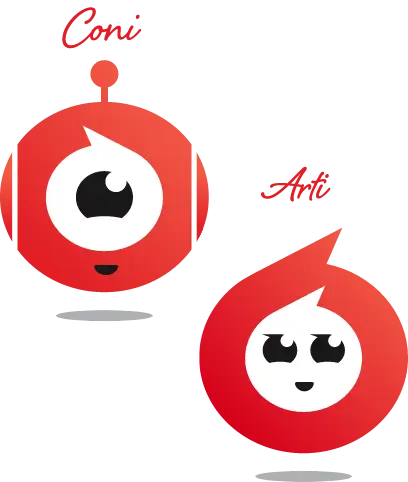
Coni and Arti are not variations of the same tool. They are deliberately different.
Coni is a logic-based, decision tree, conversational chatbot.
It presents users with structured choices and responds based on the path selected. Depending on that choice, Coni might:
- display the relevant information
- collect structured data
- trigger a workflow
- or hand the user off to a human
Coni’s strength is predictability. It ensures that the right process is followed, that required information is captured, and that escalation happens at the right moment. Its language is controlled and consistent, aligned with the organisation’s tone.
Arti, by contrast, is powered by ChatGPT.
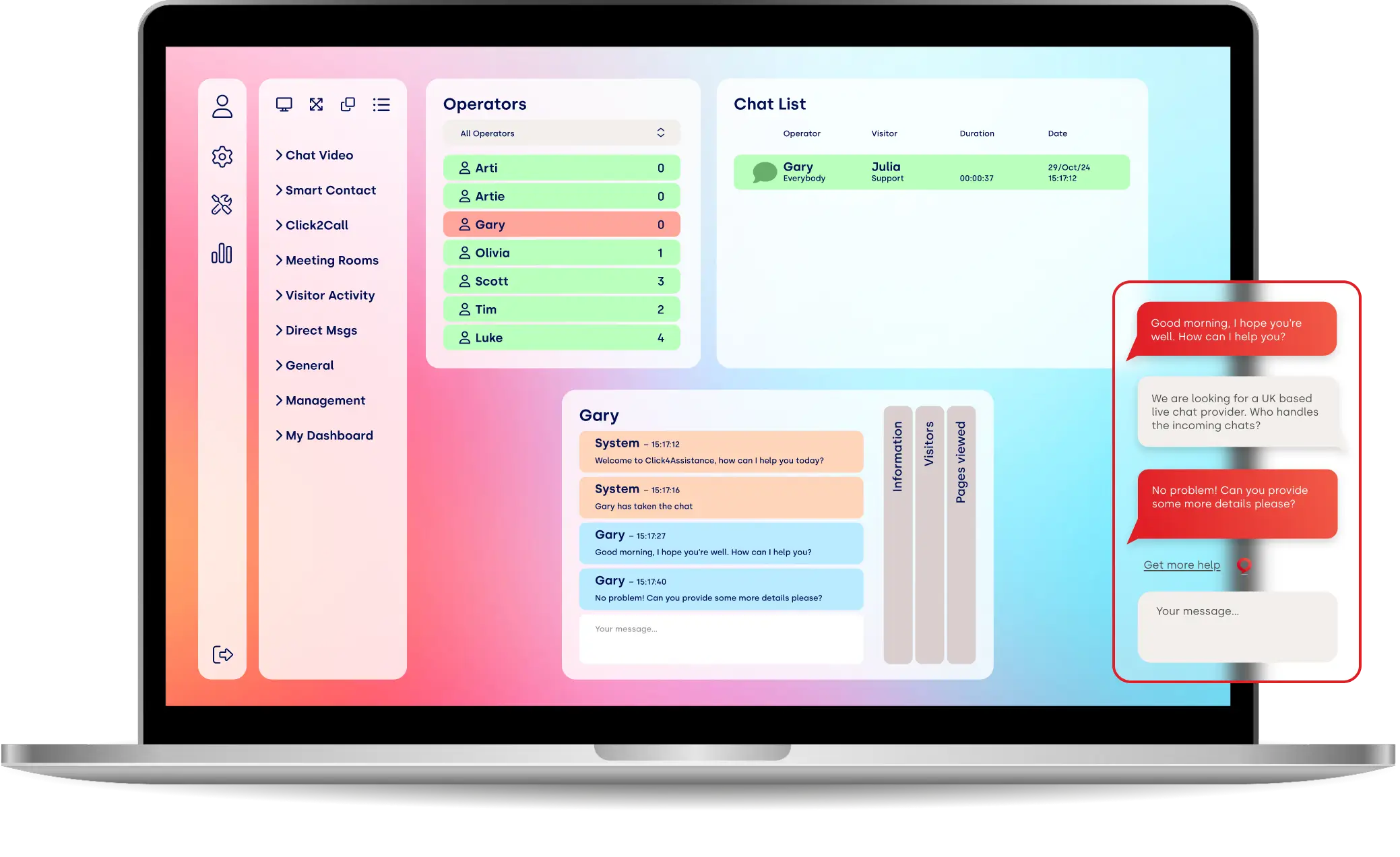
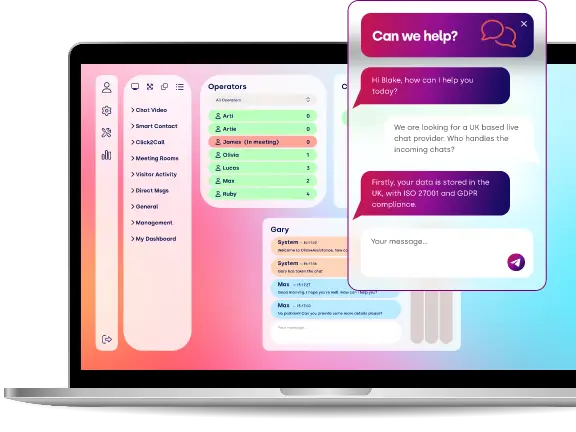
It doesn’t require users to follow a predefined route. It can be asked open-ended questions, handle follow-ups, reframe explanations, and explore edge cases. Arti is an ai powered customer engagement tool, which is conversational, adaptive, and flexible in how it responds.
These differences are intentional.
And they mirror successful human partnerships remarkably well.
Romantic Parallels: Structure and Freedom Need Each Other
In romantic relationships, tension often arises when both partners try to play the same role.
If both insist on spontaneity, nothing gets planned.
If both insist on structure, life becomes rigid.
Healthy relationships usually involve a balance: someone who ensures things are covered, and someone who keeps the conversation open. Someone who handles the logistics, and someone who explores possibilities.
Coni and Arti work the same way.
Coni provides structure. Arti provides freedom.
Coni reduces uncertainty by narrowing options. Arti reduces anxiety by allowing exploration.
Neither replaces the other. Together, they create stability and flexibility, which is exactly what most people want from both relationships and systems.
Scenario 1: Brokers, Underwriters, and the Need for Clear Routing
Consider a common workflow in insurance: a broker needs policy information, and the request is routed to an underwriter or back-office team.
Brokers may not know what information is required to process a request. Underwriters need specific details before they can respond accurately. And when the wrong information is provided. or when a request is misclassified, the result is delays, repeated follow-ups, and frustrated customers.
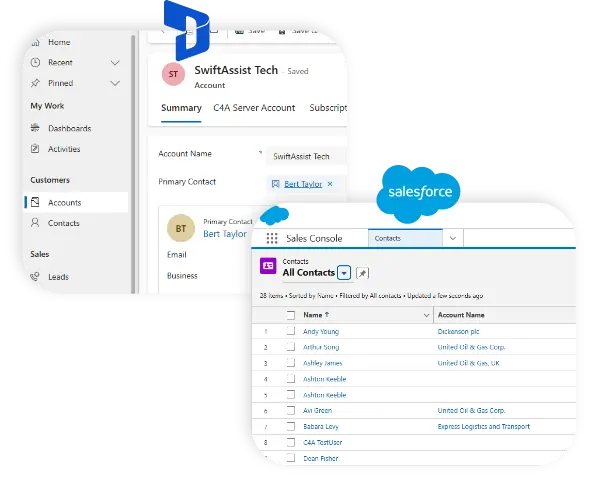
This is where Coni plays a critical role. As a decision-tree bot, Coni can guide the broker through a structured set of options, ensuring the request is routed correctly. For example, Coni can present choices like:
“Do you need policy wording, coverage confirmation, or claims history?”
“Is this a new policy, renewal, or mid-term adjustment?”
“Which product line does this relate to?”
Based on the broker’s selections, Coni can display the relevant answer, collect the required data, or hand the request over to a human underwriter when needed. The bot ensures the process is consistent and compliant with internal workflows, and the language stays aligned with the organisation’s tone, so it doesn’t feel robotic or unfriendly.
However, that’s only part of the story. Brokers often have questions that don’t fit neatly into a decision tree. They may need context, clarification, or quick access to policy details, and they want it in the same interaction.
That’s where Arti, the conversational ai chatbot becomes valuable.
Arti can connect to back-end systems and look up policy information in real time. Instead of asking the broker to manually locate policy documents or wait for a human response, Arti can retrieve details like coverage limits, exclusions, renewal dates, and endorsement history. It can answer questions such as:
“What’s the coverage limit for this policy?”
“Has this policy been amended in the last 12 months?”
“Can you confirm the renewal date and premium amount?”
Because Arti is conversational, brokers can ask follow-up questions, clarify ambiguities, and get responses that feel natural rather than procedural.
In this workflow, Coni and Arti complement each other in a way that resembles a strong professional partnership. Coni ensures the request is routed correctly and that the required information is captured. Arti provides the contextual understanding and system access that brokers need to move quickly. Together, they reduce friction, speed up responses, and allow underwriters to focus on high-value decision-making rather than basic information retrieval.
Scenario 2: Customer Service and Escalation
In customer service environments, structure is essential, but so is empathy.
Coni ensures that customers are routed correctly:
- Is this a billing issue or a technical fault?
- Has this issue already been logged?
- Does it meet criteria for escalation?
By using a decision tree, Coni prevents misrouting and ensures service-level agreements are met. It also knows when to hand off to a human agent, rather than attempting to resolve issues it shouldn’t.
Arti, meanwhile, handles the conversational layer:
- answering clarifying questions
- explaining why certain steps are required
- setting expectations about timelines and next actions
If a customer says, “This is frustrating, I’ve tried this before,” Arti, the AI agent for customer service, can acknowledge that and explain what’s different this time, without altering the underlying process.
In human terms, this is the difference between someone who manages the system and someone who manages the relationship. Both are necessary. Neither should be doing the other’s job.

Scenario 3: Public Services and High-Stakes Decisions
In public-sector contexts, the stakes are even higher.
Processes exist for a reason: fairness, consistency, auditability. Coni excels here. By presenting fixed choices and enforcing decision logic, it ensures that:
- eligibility criteria are applied consistently
- required information is collected
- decisions can be traced and reviewed
But citizens don’t experience services as flowcharts. They experience them as moments of stress, uncertainty, or urgency.
That’s where Arti plays a critical role.
A user might ask:
- “Why do you need this information?”
- “What happens if I choose this option?”
- “Can you explain this in simpler terms?”
Using an AI agent for customer support can provide explanations without altering outcomes. It doesn’t change the rules, it explains them; and that distinction is crucial.
In healthy relationships, this is the difference between enforcing boundaries and explaining them. One without the other could feel either cold or chaotic.
Professional Partnerships: Why This Division Works
In workplaces, the best partnerships aren’t about splitting work evenly. They’re about splitting work sensibly.
One person owns process integrity, another owns communication and context.
When those roles blur, problems arise. Processes get bypassed, conversations become inconsistent, accountability becomes unclear.
Coni and Arti avoid that by design.
Coni never improvises.
Arti never overrides the route.
Each system knows when to defer to the other, which is uncommon in both human teams and tech systems.
A Different Take on Valentine’s Day
Valentine’s Day often celebrates emotional intensity, but most successful relationships depend on something else entirely: predictability.
Knowing how someone will respond.
Knowing where responsibility lies.
Knowing that if something can’t be done, you’ll get a clear explanation rather than a vague promise.
Coni and Arti embody that kind of partnership.
There are no grand gestures here. Just steady, complementary behaviour that builds trust over time. It might not be flashy, but it builds systems that earn trust through consistency.
Why Do AI Chatbots Matter Now?
As AI becomes embedded in everyday work, organisations are learning a hard lesson: users don’t want magic. They want systems that behave consistently, explain themselves clearly, and escalate appropriately.
By pairing a decision-tree system like Coni with a conversational AI chatbot like Arti, organisations get the best of both worlds:
- structure without rigidity
- conversation without chaos
- automation without abdication of responsibility
This isn’t about replacing humans. It’s about designing partnerships between systems, and between systems and people, that respect boundaries and reduce resourcing needs.
The Real Lesson of Partnership
Whether romantic or professional, strong partnerships share a few traits:
- clear roles
- mutual respect
- trust built through consistency
- an understanding that not everything has to be shared to be aligned
Coni and Arti demonstrate that principle in technical form.
Coni provides certainty.
Arti provides understanding.
Together, when you create chatbot for website it can deliver dependable results, which is precisely what both workplaces and relationships require.
After Valentine’s Day
The flowers will wilt, the LinkedIn Valentine’s posts will scroll away, but the idea behind this partnership is worth keeping.
As we design AI systems for real work, in real organisations, we should spend less time asking how clever they are, and more time asking how well they work together.
Coni and Arti succeed because they know their roles and trust each other to handle the rest.
That’s not just good technology design, it’s good partnership design.
As in work, and in life, the partnerships that endure are the ones built on clarity, not chemistry.