














Are AI Agents for Websites Breaking Down the Barriers Between Sales, Marketing and Customer Service?
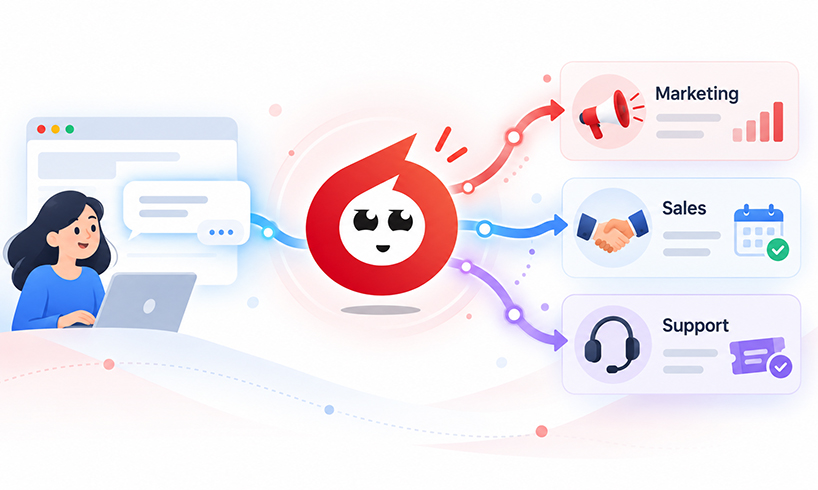



Rather than deploying separate AI tools within individual departments, businesses are beginning to explore agents capable of operating across a much larger part of the commercial journey. An agent can engage a visitor, answer questions, understand their requirements, identify buying intent, gather relevant information and decide when the conversation should be handed to a salesperson or another human specialist.
Historically, in order to create manageable structures businesses have divided the customer journey into departments.
Marketing attracts attention and generates leads.
Sales qualifies those leads and converts them into customers.
Customer success/support takes over once the deal has been done, answering questions and resolving problems.
However, customers don’t necessarily experience their journey in the way we plan. Someone visiting a website may be researching a product, comparing suppliers, looking for a price, trying to solve a problem or deciding whether they are ready to buy. They don’t know whether their question belongs to marketing, sales or customer success. What matters is whether the business can understand what they need and respond appropriately.
AI agents could bridge that gap.
The interesting question is whether AI agents for business will begin to break down some of the organisational boundaries between functions.
From departmental tools to customer journeys
Businesses have spent the past few years experimenting with generative AI to help individual teams complete familiar tasks more quickly. Salespeople might use AI to prepare for meetings or draft follow-up emails, while marketing teams use it to develop content, and customer service teams turn to it for answering routine enquiries. The more interesting question now is what happens when organisation start to connect them.
McKinsey’s 2026 B2B Pulse Survey, which draws on responses from nearly 4,000 buyers and sellers across 13 countries, suggests that some organisations are beginning to see the benefits of embedding AI more deeply into their commercial operations. Among growth leaders that have incorporated AI into their workflows, 59 per cent identify improved seller efficiency a s the primary benefit with 53 per cent reporting improvements in the customer experience. However less than 10 per cent of organisations have scaled AI within any of the individual departments, suggesting that much of the market is still working out how these technologies fit into established ways of working.
The AI agents role does not have to sit within a single department. McKinsey points towards the use of agentic AI across end-to-end commercial workflows, bringing together data, decision-making, human judgement and automated assistance across activities such as identifying opportunities, preparing proposals, pricing and supporting customers after a sale.
The traditional customer journey provides a useful example. Marketing attracts someone to a website and encourages them to make an enquiry, sales qualifies that enquiry and explores whether there is a commercial opportunity, while customer success/support usually becomes involved once a purchase has been made. An AI agent can potentially move through these stages without requiring the customer to understand where one department ends and another begins. Someone might arrive on a company’s website after reading an article and start by asking a relatively straightforward question about a product. The agent could provide information, respond to follow-up questions and gradually establish what the visitor is trying to achieve. The conversation itself provides additional context about the potential customers requirements.
As that discussion develops, a visitor who was initially researching a subject might begin asking about implementation, pricing or whether a particular product could meet a specific requirement. The agent could recognise those signals, ask relevant qualifying questions and establish whether it would be useful to involve somebody from sales, allowing what began as a marketing interaction to develop naturally into a sales conversation rather than requiring the visitor to start again elsewhere.
The same principle can work in reverse. If the person asking the questions is already a customer and needs help with an existing product, the conversation may be better suited to customer support. Instead of sending them away to another part of the website or asking them to repeat their enquiry through a different channel, the agent could identify the nature of the request and direct it to the appropriate team, transferring the content of the chat with it. The departmental responsibilities remain, but the customer does not necessarily have to experience the boundaries between them.
The lead form starts to look old-fashioned
This has implications for the lead generation, contact detail collecting, online form. The conventional digital journey frequently asks someone to read content, click a call to action and submit their contact details. The information is then passed into a CRM or marketing automation platform and/or sent to sales.
The weakness in this process is that a potentially valuable customer has arrived ready to interact, but the business responds by asking them to fill in boxes and wait.
An effective AI agent for business offers a different model. Instead of simply capturing a lead, it can begin to understand:
- What problem are they trying to solve?
- What information do they need?
- Are they exploring generally or actively considering a purchase?
- Which products appear relevant?
- Is there an obvious next step?
Marketing still has to create demand, establish the brand, develop useful content and give potential customers reasons to engage. But the point at which marketing ends and sales begins becomes harder to define.
McKinsey describes agents conducting outreach, nurturing responses, interpreting intent, capturing needs and scheduling meetings before handing an opportunity over when it becomes sufficiently “warm”. The report also highlights the ability of agents to preserve context across interactions and route opportunities towards the appropriate human.
Customer success becomes part of the growth engine
Customer success has traditionally been treated as a post-sale function. Its job begins after the sale is done. Yet existing customers are also prospects for renewals, upgrades, additional products and services. An agent dealing with a support question may therefore encounter commercial intent just as easily as an agent speaking to a new website visitor.
Imagine an existing customer asks whether their current package supports a new requirement. A conventional chatbot might locate the relevant help article and provide an answer. A human support advisor could potentially understand the customer's existing products, answer the question, recognise that another service might meet their requirement and determine whether a conversation with an account manager would be useful. The support interaction has suddenly become a sales opportunity.
Equally, sales increasingly depends on information generated after the initial transaction. Customer questions, service histories, account activity and previous interactions can all provide useful context about what somebody may need next.
McKinsey argues that agentic AI can combine internal information with external account intelligence to build a continuously developing view of the customer and identify opportunities such as cross-selling, churn prevention and winning back lost business. This emphasises the point that customer service data is commercially valuable and should not remain inside a separate support system.
Is continuity the real advantage?
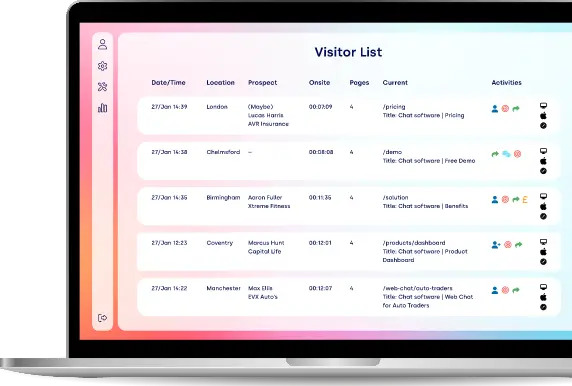
One of the frustrations of dealing with large organisations is repeatedly explaining the same thing. Marketing knows somebody downloaded a guide. Sales knows they attended a demonstration. Customer support knows they raised a ticket. The customer knows that all three interactions happened with the same company.
The organisation may not join them together nearly as effectively.
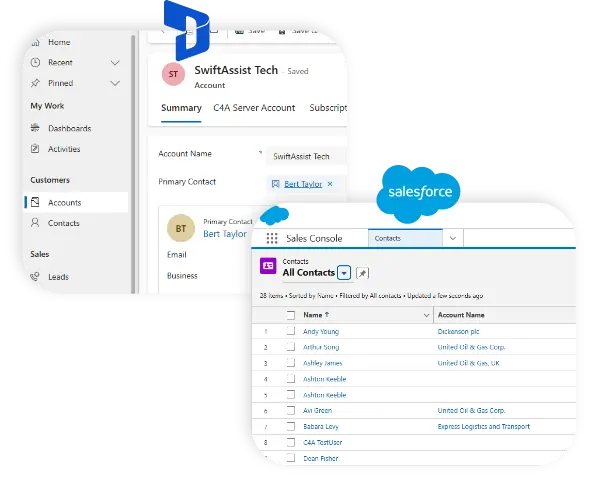
AI agents potentially provide an orchestration layer across those interactions. If designed properly, an agent can draw on appropriate information from CRM platforms, product information, previous conversations and other business systems to understand the context surrounding an interaction.
The customer does not have to start from zero every time the organisational chart says they have entered another department.
There is evidence that this matters. McKinsey's research reports that inconsistent information across teams is now the leading reason B2B buyers switch suppliers, ahead of difficulties accessing knowledgeable representatives and tracking orders across channels.
Breaking down commercial silos is therefore not simply an internal efficiency exercise. It can directly affect the experience customers receive.

Breaking silos is harder than installing an agent
An agent (whether human or AI) cannot provide a joined-up customer experience if the underlying data remains fragmented, inaccurate or inaccessible. However, not every piece of customer information should automatically become available to every AI system. Permissions, security, privacy, governance and appropriate human oversight become more important as agents are given access to more systems and greater ability to act.
Does this make the organisational challenge even greater?
If an AI agent contributes to marketing, qualification, sales and service, who owns it? Which department sets its objectives? How is success measured? What happens when improving one departmental metric produces a worse outcome somewhere else?
A marketing team rewarded for generating as many leads as possible may have very different priorities from a sales team interested in a smaller number of highly qualified opportunities. Customer support may be measured on resolution times, while account management is interested in retention and expansion.
Putting an intelligent agent across those processes without reconsidering the incentives underneath them risks automating the silo rather than removing it.
This helps explain why McKinsey places so much emphasis on redesigning workflows rather than simply deploying technology. Its research argues that businesses need to move from siloed functions including sales, marketing, pricing and customer service towards a connected model organised around human–AI teams and end-to-end commercial journeys.
The human handover becomes more important!
None of this means that every customer interaction should be automated.
There are moments when people want human involvement. Complex negotiations, sensitive complaints, strategic accounts and unusual requirements demand judgement that should not simply be delegated to an autonomous system.
The more useful question is where the human should enter the conversation.
An agent capable of dealing with routine enquiries, gathering information and understanding intent could allow employees to enter at precisely the point where their expertise adds most value. A salesperson could receive a genuinely qualified opportunity together with the relevant context rather than starting with a name and an email address. A customer support specialist could encounter a problem already summarised rather than asking the customer to repeat the story.
McKinsey makes a similar argument: agents can perform more searching, synthesising, drafting and administrative work, allowing sellers to concentrate on relationship building, problem solving and conversations requiring judgement.
One commercial conversation
Marketing, sales and customer support will not disappear. Each requires different expertise, and businesses will continue to need people who understand brand building, demand generation, commercial negotiation, account management and customer support.
If an AI agent for business can engage someone attracted by marketing, answer their questions, understand their intent, qualify an opportunity, support an existing customer and bring the appropriate human into the conversation when necessary, the commercial journey becomes a continuous conversation instead.
That is a more ambitious vision for AI than simply writing sales emails faster or automatically producing marketing copy. It requires businesses to connect data, rethink workflows and decide carefully where agents should act and where humans should take over.
Frequently asked questions
What is an AI agent for customer service?
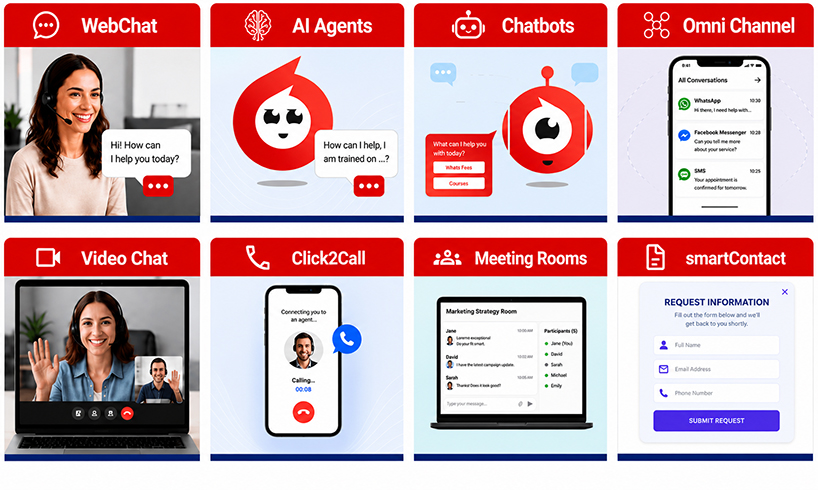
An AI agent for customer service is a system that can use information, follow a process and take actions towards a particular goal rather than simply generating a response to a single prompt. In a commercial setting, that might involve answering a prospective customer’s questions, understanding what they are looking for, identifying signs of purchasing intent and deciding when an enquiry should be passed to a salesperson or another team.
How are conversational AI chatbots different from traditional chatbots?
Traditional chatbots have generally been designed around relatively narrow tasks, such as answering frequently asked questions or directing visitors towards particular pages. Conversational AI chatbots can potentially work across a broader process, drawing on available context and business information to determine what should happen next. This means a conversation does not necessarily have to follow a predefined path and can develop according to what the customer actually needs.
Can AI agents qualify sales leads?
AI agents can help with lead qualification by gathering information during a conversation and identifying factors that indicate whether there may be a genuine sales opportunity. For example, an agent might establish what problem somebody is trying to solve, the type of product they are interested in and whether they are actively considering a purchase before passing the conversation, together with its context, to a salesperson.
Can AI agents for business replace sales, marketing or customer service teams?
The more immediate change is likely to be in how work moves between these teams rather than the disappearance of the teams themselves. AI agents for business can handle routine interactions, gather information and help determine where an enquiry should go, while people remain important for areas such as relationship building, complex negotiations, unusual customer problems and situations requiring judgement.
What should businesses consider before introducing AI agents?
The effectiveness of an AI agent for website depends on more than the technology itself. Businesses need to consider the quality and accessibility of their data, which systems an agent should be allowed to use, privacy and security requirements, how decisions are monitored and the points at which a person should take over. They may also need to reconsider processes and responsibilities that were originally designed around separate departmental workflows.