














Pole Position for Customer Experience: What the British Grand Prix Can Teach Businesses About AI Agents





Every summer, Silverstone becomes the centre of the motorsport world. Hundreds of thousands of fans gather to watch the British Grand Prix, while millions more follow the action from home. It's one of the highlights of the sporting calendar and, as the birthplace of the Formula One World Championship, holds a special place in the history of motorsport.
For most spectators, the focus is naturally on the drivers. They are the faces on the podium, the names in the headlines and the ones who ultimately take the chequered flag. Yet anyone with even a passing interest in Formula One knows that success is never down to one individual. Behind every car is an extraordinary team of engineers, mechanics, strategists, analysts and technicians, each playing their part in preparing the car, interpreting data and making hundreds of decisions during the race. The driver may be the public face of the team, but they are never working alone.
This is an interesting parallel with customer service.
Whether you're a local authority dealing with a surge in enquiries, a university supporting prospective students, a housing association managing repair requests or a business looking after thousands of customers, your frontline teams are under increasing pressure. Customers expect quick responses, accurate information and a seamless experience regardless of whether they contact you through live chat, WhatsApp or email.
Meeting those expectations isn't simply about recruiting more people. Budgets are under pressure, enquiry volumes continue to grow and experienced staff are increasingly expected to do more with the time they have. That's why the conversation around AI has changed so dramatically over the past year. The question isn't really whether AI has a role to play anymore, it’s now where it can have the biggest impact without losing the personal service that customers value. That's where AI agents are starting to come into their own.
More than just another chatbot
The term 'AI agent' is becoming progressively more common, but it's also one of the most misunderstood. Many people assume it's simply another name for a chatbot.
Traditional conversational chatbots (like Click4Assistance’s CONI) are typically designed to answer questions by following predefined conversation paths. They are extremely effective when customers ask predictable questions such as opening hours, delivery times or how to reset a password and can save organisations countless hours by handling routine enquiries that don't require human intervention.
AI agents for customer service take that concept several steps further. Rather than simply answering questions, an AI agent can understand what the customer is trying to achieve and actively help move the enquiry to a resolution. It can collect information, search knowledge bases, interact with business systems, complete routine tasks and decide what should happen next based on rules that have been defined by the organisation. So, it becomes more like another member of the team.
Like the race engineer in Formula One, an AI agent isn't there to take over. Its purpose is to provide the right information, at the right time, so that people can make better decisions and deliver a better performance.
That's an important distinction because the most successful AI implementations aren't about replacing people. They're about removing the repetitive work that prevents people from doing what they do best.
Has Customer service become more complicated?
It doesn’t seem that long ago that customer service was relatively straightforward. A customer would telephone or send an email, speak to a member of staff and receive an answer. Today's customer journey looks very different.
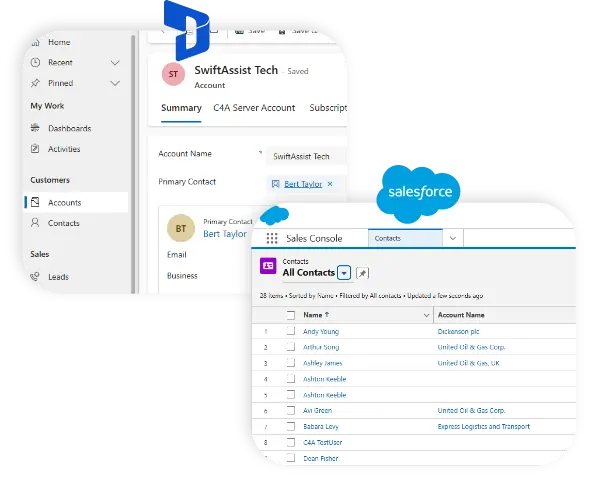
At the same time, advisors are often working across multiple systems. They may need to search a CRM, consult an internal knowledge base, update another application and refer to company process before they can answer what appears to be a simple question.
None of these tasks is particularly difficult in isolation, but together they create friction.
- Customers wait longer than they should.
- Advisors spend valuable time searching for information instead of helping people.
- Managers struggle to balance workloads as enquiry volumes fluctuate throughout the day.
These are exactly the kinds of challenges AI agents for customer support are designed to address. Instead of asking advisors to spend several minutes gathering information, an AI agent can do much of that work automatically, so that by the time a conversation reaches a human colleague, the customer's details have already been collected, the reason for the enquiry identified and any relevant background information gathered.
Small improvements make the difference
Formula One has long been associated with the idea of marginal gains. Teams spend millions of pounds developing improvements that might save only a fraction of a second over the course of a lap. To anyone outside the sport, that level of precision can seem extraordinary, however within Formula One, it's simply accepted that enough small improvements eventually become a significant competitive advantage.
Customer service isn't that different.
When organisations are trying to transform customer satisfaction, improvements come from removing dozens of small frustrations that occur throughout the day.
- A customer no longer has to repeat information because it has already been collected.
- An advisor doesn't need to search through three different systems to find an answer.
- Routine enquiries are resolved automatically, leaving experienced staff available for more complex conversations.
Collectively, these changes create a noticeably smoother experience for both customers and employees. AI agents for business are attracting so much interest because they don't just automate individual tasks, but rather they help remove the countless small delays that gradually wear away at productivity and customer satisfaction.
However, organisations should recognise still need empathy, judgement and experience. Customers facing sensitive situations want to speak to another person, therefore the real opportunity lies in allowing technology to handle the routine work so that people have more time to focus on the conversations where they make the most difference.

From theory to practice
A local authority makes a great example. A spell of severe weather can generate thousands of enquiries in a matter of hours. Residents want to know whether schools are open, if bin collections have changed or whether roads have been affected. During the heatwave, councils used WhatsApp Broadcast to let residents know that refuse collections would start earlier in the day to protect collection crews from the hottest temperatures. It was a simple change, but one that prevented a huge number of unnecessary enquiries.
A conversational AI chatbot can take that a step further. Rather than simply sending an update, it could answer follow-up questions, direct residents to the correct service, identify those who need additional support and escalate more complex enquiries to the appropriate team.
The same principle applies in higher education. Universities experience enormous peaks in demand during Clearing, enrolment and the start of the academic year. Prospective students want quick answers about courses, accommodation, finance and admissions, often outside normal office hours. An AI agent can deal with many of those routine enquiries immediately, while ensuring more complex or sensitive conversations are passed to the right member of staff with all the relevant information already gathered.
Housing associations face similar challenges. A resident reporting a repair wants reassurance that it's being dealt with. An AI agent can collect details, ask relevant questions, check whether the issue meets emergency criteria, book an appointment where appropriate. Staff remain in control, but much of the administration happens automatically in the background.
These are not futuristic examples. They are practical applications of technology that allow organisations to respond more efficiently while giving employees more time to focus on the conversations where their experience and judgement add the greatest value.
Starting small delivers big rewards
One of the biggest misconceptions surrounding AI is that adopting it requires a large-scale transformation project. In reality, the most successful implementations often begin with a single department or challenge.
Do your advisors spend too much time answering the same handful of questions each day? Maybe customers struggle to find information outside office hours, or staff are constantly moving between systems to retrieve the information they need? These are often the best places to begin because the benefits are clear, measurable and are felt almost immediately by both customers and the team.
Starting with one well-defined objective also gives people confidence. Employees can see that conversational AI for customer service is helping to remove repetitive tasks rather than making their roles less important. Customers benefit from quicker responses without feeling they've been pushed into an automated process that doesn't understand their needs.
Once that confidence has been established, organisations can build on those early successes and introduce AI agents into other areas of the business where they will have the greatest impact.
Keeping people at the centre of the experience
As AI continues to evolve, it's easy to become distracted by what the technology can do. New capabilities appear almost weekly, each promising to automate another process or solve another business challenge. However, organisations seeing the greatest success are not those chasing every new development, they are the ones that remain focused on the customer experience.
Customers don’t remember the systems an organisation uses behind the scenes. They remember whether their enquiry was handled efficiently, whether they received clear information and whether they felt listened to throughout the conversation.
AI agents can help make those interactions smoother by reducing delays, removing repetitive administration and ensuring advisors have the information they need when they need it. What they cannot replace is empathy, reassurance and the ability to understand the nuances of a conversation that really matters. That's why the future of customer service is about combining the strengths of both AI and humans.
Crossing the finish line
Formula One has changed enormously since the first World Championship race was held at Silverstone in 1950. The cars are faster, the technology is more sophisticated, and data now plays a far greater role than anyone could have imagined in the sport's early days.
What hasn't changed is the importance of teamwork.
At Click4Assistance, we believe technology should make customer service feel more personal, not less. Whether you're exploring AI for the first time or looking to build on your existing customer engagement strategy, our team can help you identify where AI agents for business can deliver genuine value for your organisation, your employees and your customers.